 TruVet Pet Care Clinic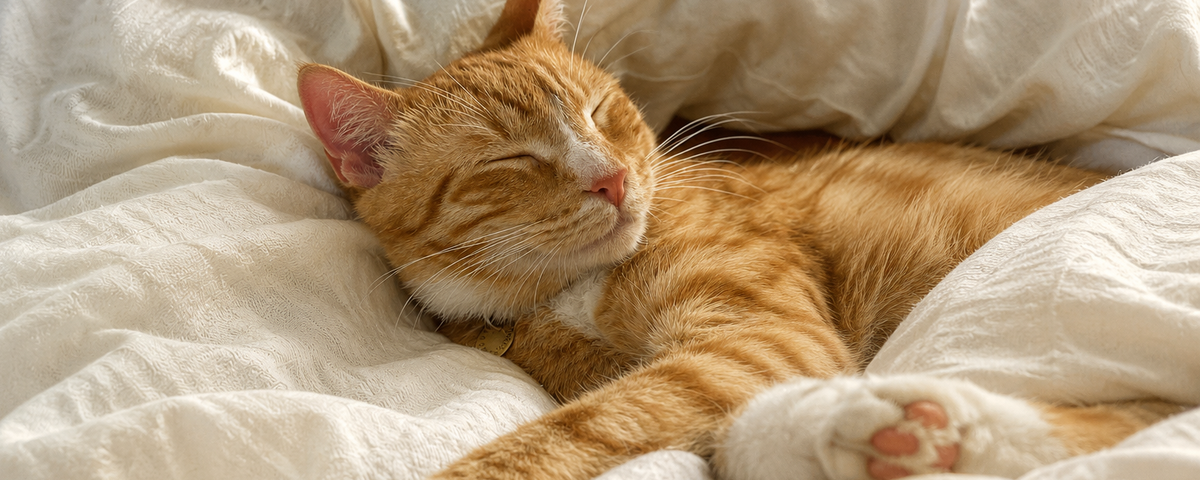
Most people assume a purring cat is simply a happy cat. The real science is stranger than that, and it explains why some cats purr through pain rather than pleasure.
Why Do Cats Purr, and Can It Really Heal Bones?
By Dr. Brajmadhuri, TruVet Pet Care Clinic, Sector 79, Gurgaon
There is a particular sound that most cat owners find deeply soothing, that low, steady rumble a cat makes curled up on your lap or stretched out in a warm patch of sun. It is easy to assume purring simply means a cat is content, and often it does. But if you have ever heard a cat purring at the vet's clinic while clearly frightened, or purring softly after an injury, you have already noticed that the real story is more complicated than happiness alone.
How a cat actually produces a purr
Purring comes from rapid, repeated movement of the muscles in a cat's voice box, working together with the diaphragm, at a rate of roughly twenty five to fifty cycles per second. This happens on both the inhale and the exhale, which is part of why a purr sounds so continuous and steady rather than broken up like a growl or a meow. Unlike meowing, which cats mostly reserve for communicating with humans rather than each other, purring appears to serve a more internal, self directed purpose.
The surprising healing theory
One of the more genuinely interesting pieces of research on this topic looked closely at the specific frequency range that cat purrs fall into, roughly twenty five to one hundred and fifty hertz. That range overlaps with frequencies that other research has associated with improved bone density and tissue repair in various contexts. The idea this raises is intriguing, that a cat's purr may function as a kind of low grade physical therapy, potentially aiding healing and possibly explaining why cats seem to recover from certain injuries and surgeries relatively well compared to their size and activity level.
It is worth being honest about the limits of this idea. The research behind it is interesting but still fairly early, and it has not been established as settled scientific fact in the way that, say, vaccine effectiveness has. Think of it as a genuinely compelling hypothesis rather than a proven mechanism, one more piece of a puzzle that researchers are still working out.
Why cats purr when they are scared or hurt
This is the part that surprises most cat owners the first time they learn about it. Cats do not only purr when they are happy. They also purr when they are anxious, in pain, giving birth, or even in the final moments of life. This has led many animal behaviourists to think of purring as partly a self soothing mechanism, similar to how a person might hum or breathe slowly to calm themselves during a stressful moment, rather than purring being a pure signal of positive emotion.
This matters practically, because it means you cannot use purring alone as proof that your cat is happy or healthy. A cat purring at the vet's office is very likely doing it to self soothe through a stressful situation, not because the visit itself is enjoyable. A cat who purrs constantly after an injury may be in genuine pain and using purring as a coping mechanism, not necessarily feeling fine. Reading a cat's overall body language, including posture, ear position, tail movement, and appetite, gives a much fuller picture than the purr alone.
Purring as communication, not just self soothing
There is also a social side to purring that is worth knowing about. Kittens begin purring within days of birth, long before their eyes even open, and this seems to help them communicate with their mother during nursing, signalling that all is well and encouraging continued care. Some researchers have also identified a specific type of purr, sometimes called a solicitation purr, that cats use to ask for something from their owner, often food. This particular purr has a slightly different, more urgent quality to it, layered with a higher pitched, almost cry like sound that seems to specifically trigger a caregiving response in humans.
What this means day to day
None of this should change how you enjoy your cat's purring, which remains one of the more genuinely pleasant parts of living with a cat. What it should change is how you interpret it in situations where something else seems off. Alongside purring, it helps to check for these signs of how your cat is actually doing:
- Normal appetite and interest in food
- Regular litter box habits with no straining or avoidance
- Ears relaxed and forward rather than flattened
- Willingness to move around normally rather than hiding
- A tail that is loose rather than tucked tightly against the body
A cat who is purring but also hiding, not eating, or showing changes in litter box habits is not necessarily a happy, healthy cat. She may be using purring to cope with something that is actually bothering her.
If your cat has recently had surgery, an injury, or seems unwell in any other way, keep purring in context rather than treating it as reassurance on its own. A quick call to your vet costs little, while assuming everything is fine purely because your cat is purring can occasionally mean missing something that needed attention.
The TruVet takeaway
Purring is genuinely one of the more fascinating things about cats, precisely because it does not mean just one thing. Sometimes it is contentment, sometimes it is a kitten's early communication with her mother, and sometimes it is a cat quietly working through pain or fear using the only self soothing tool she has. The bone healing idea remains a compelling, if not fully settled, possibility layered on top of all of this. Enjoy the sound, but do not let it be the only thing you rely on to judge how your cat is really doing.
You will find TruVet Pet Care Clinic at Shop No 4-6, opposite Bestech Park View Altura, Sector 79, Naurangpur, Gurugram, Haryana 122051. Every consultation is handled personally by Dr. Brajmadhuri, and we are open all seven days, 10am to 8pm, for OPD consultation, vaccination, deworming, surgery, and health checkups for both dogs and cats. Message us on WhatsApp at +91 98710 10355 if something about your cat feels off, purring or not.
Frequently asked questions.
Is it true that a cat's purr can help heal broken bones?
There is an interesting scientific theory connecting the frequency of a cat's purr to processes that support bone healing, but it is still an early and evolving area of research rather than a settled, proven fact. It is a fascinating possibility, not a guaranteed treatment.
Why does my cat purr when she is at the vet, clearly stressed?
Purring during stressful situations is thought to be a self soothing behaviour, similar to how people might take slow, deep breaths to calm themselves. It does not mean your cat is enjoying the visit.
Can purring mean my cat is in pain?
Yes. Cats sometimes purr while injured or unwell, likely as a coping mechanism, so purring alone should never be taken as proof that a cat feels fine.
Do kittens purr from birth?
Yes, kittens can purr within just a few days of being born, well before their eyes open, and this seems to play a role in communicating with their mother during nursing.
My cat has a different sounding purr when she wants food. Is that normal?
Yes, many cats develop what researchers call a solicitation purr, a slightly more urgent, higher pitched version used specifically to prompt their owner into action, often around feeding time.
Should I be worried if my cat suddenly stops purring?
Not necessarily, since not every cat purrs the same amount, and purring frequency varies by personality. That said, a sudden, lasting change in behaviour alongside reduced purring, especially combined with appetite loss or hiding, is worth mentioning to your vet.
Questions for Dr. Brajmadhuri?
Open all 7 days, 10am to 8pm. Walk-in OPD welcome.